Why the Centurion was built
In 1943 the Department of Tank Design was asked for a new heavy cruiser tank, given the General Staff number A41. The first requirement limited it to 40 tons, a limit that was later relaxed, and a pilot batch of twenty tanks was ordered.
The first Centurions reached the Continent in 1945, too late to see action in the Second World War.
From Mk 1 to Mk 5
The Centurion Mk 1 and Mk 2 carried the 17-pounder gun. The Mk 3 brought the 20-pounder, with a stabiliser so that the gun stayed on its target while the tank moved.
The Centurion Mk 5, also written Mark 5 or Mk V, replaced the Besa machine gun with a Browning.
Centurions were built by Leyland Motors, by the Royal Ordnance Factories at Leeds and Woolwich, and by Vickers at Elswick. In all 4,423 were made before production ended in 1962.
The Mk 5/2 and the 105 mm gun
Two improvements to the Mk 5 were given numbers of their own. A Mk 5/1 is a Mk 5 with extra armour on the glacis plate, the sloping plate at the front of the hull. A Mk 5/2 is a Mk 5 re-armed with the 105 mm L7 gun in place of the 20-pounder.
The new gun owed something to an unusual piece of luck. During the Hungarian uprising of 1956 a Soviet T-54 tank was driven into the grounds of the British embassy in Budapest, where it was examined before it was handed back, and what was learned went into the 105 mm gun.
The L7 went on to arm many other Western tanks, among them the American M60.
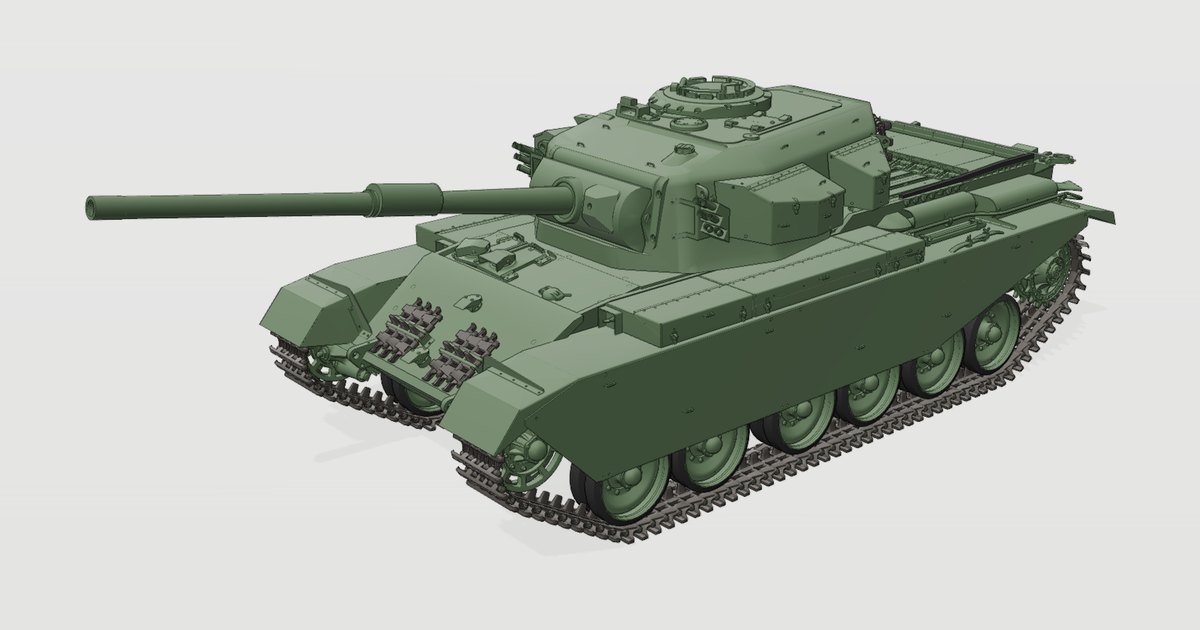
Armortek’s 1/6 scale metal kit is the Mk 5/2, with the L7 gun.
Inside the Centurion
The Centurion had a crew of four. Its engine was a Rolls-Royce Meteor, a V12 petrol engine of about 650 bhp derived from the Merlin aircraft engine, driving through a Merritt-Brown gearbox with five forward gears and two reverse.
It ran on Horstmann suspension: three units on each side, each carrying two pairs of road wheels. You can see the six wheel stations on each side of the 3D model above.
A Centurion of the Mk 5 family weighed roughly 50 tons and had a top speed on the road of about 21 mph.
In action
The Centurion first saw combat in the Korean War. The 8th King’s Royal Irish Hussars arrived in Korea in November 1950 with 29th Infantry Brigade, equipped with the Centurion Mk 3. At the Battle of the Imjin River, from 22 to 25 April 1951, their tanks were the brigade’s armoured support.
At Suez in November 1956, Centurions of the 6th Royal Tank Regiment landed at Port Said to support the Royal Marines.
In the Indo-Pakistani war of 1965, Indian Centurions fought Pakistani Patton tanks at Asal Uttar, in the Khem Karan sector, from 8 to 10 September.
Australia sent Centurions to Vietnam in February 1968 with C Squadron, 1st Armoured Regiment. These were Mk 5/1s that kept the 20-pounder gun. They played an important part in the battles of Fire Support Bases Coral and Balmoral in May 1968, and fought at Binh Ba in June 1969. In all 58 Centurions served in Vietnam.
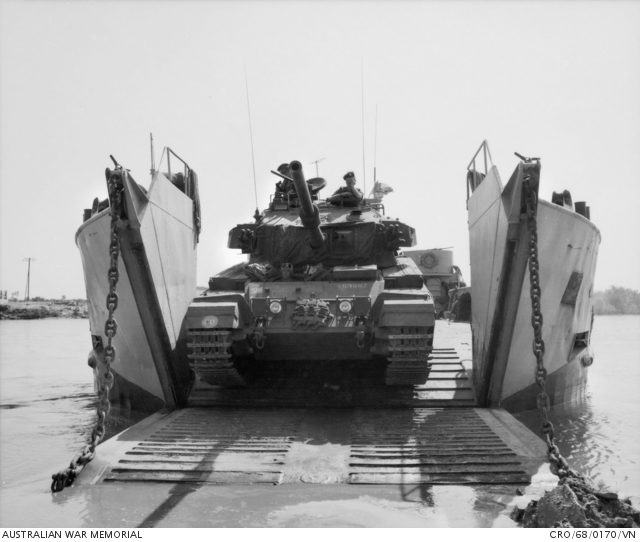
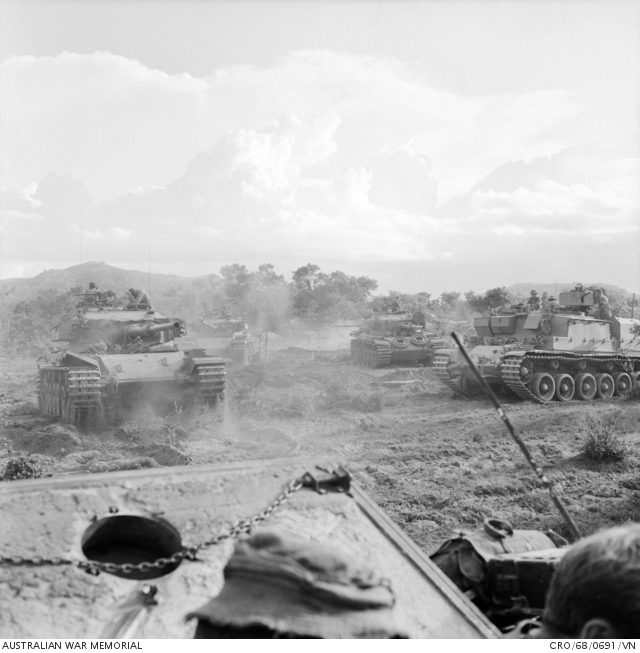
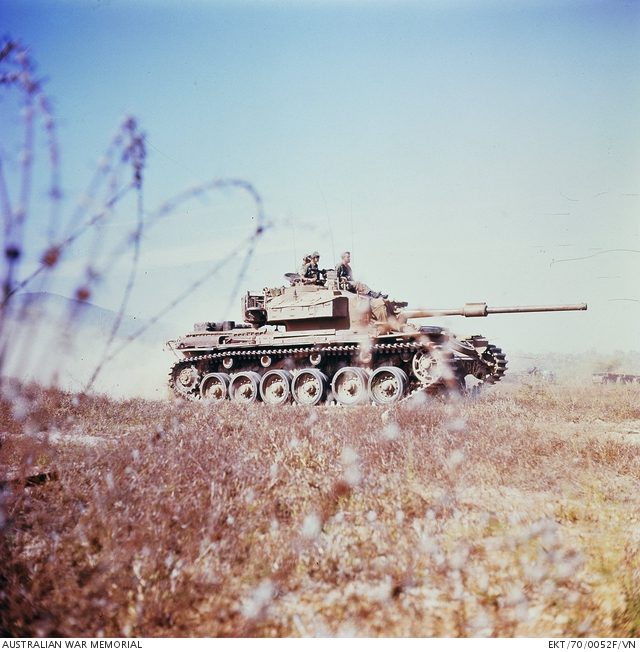
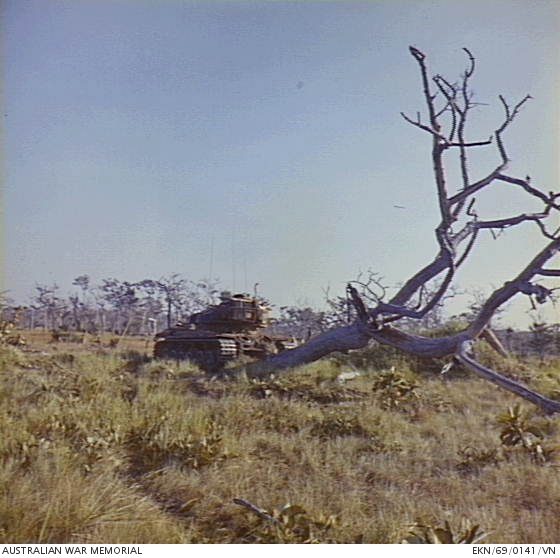
One of them had already had a remarkable life. In 1953 Centurion 169041 was placed close to a nine-kiloton atomic test at Emu Field in South Australia, and survived it. The same tank later served in Vietnam, where it was hit by a rocket-propelled grenade in 1969. It is known as the Atomic Tank.
Israel named its Centurions Sho’t, and they defended the Golan Heights against Syrian armour in October 1973. South Africa rebuilt its Centurions as the Olifant.
A long life
Besides Britain, the Centurion served with Australia, Canada, Denmark, Egypt, India, Iraq, Israel, Jordan, the Netherlands, New Zealand, South Africa, Sweden and Switzerland.
The Chieftain succeeded it as Britain’s main battle tank in the mid-1960s. Even so, a Royal Engineers version armed with a 165 mm demolition gun, the Centurion AVRE, went to the Gulf War in 1991, more than 40 years after the first Centurions were built.
The Armortek 1/6 scale Centurion Mk 5/2 is modelled on the real tank. Turn it in 3D at the top of this page, and see the metal RC tank kit in the Armortek shop.